
Acronyms in digital marketing multiply faster than algorithm updates. A few years ago it was just SEO. Then came SEM, AEO, GEO, and now AIEO. The field keeps generating new terms, and it’s not always clear whether they represent genuinely distinct things or just marketing rebranding of the same ideas.
AI SEO and AIEO — AI-Enhanced Engagement Optimization — are actually different enough to deserve careful distinction. Choosing between them, or knowing how to combine them, matters quite a lot depending on what your business is actually trying to accomplish.
The Core Distinction
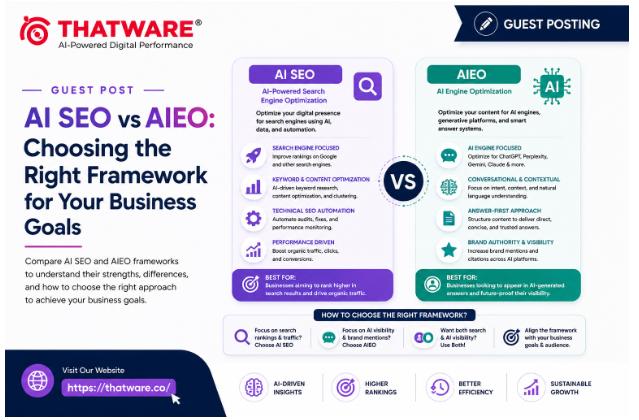
AI SEO, in the broadest sense, is about using artificial intelligence to improve how your content performs in search engine results pages. The goal is ranking — visibility, organic traffic, authority signals. The primary audience is, ultimately, a search algorithm, with the intent of reaching human users downstream.
AIEO shifts the frame. It focuses on how AI systems — particularly large language models, conversational search interfaces, and AI-generated answer engines like Perplexity, ChatGPT browsing, or Google’s AI Overviews — represent, cite, and recommend your brand or content. The question isn’t just “do you rank?” but “are you the answer that gets surfaced when an AI is asked something in your domain?”
These sound similar. They’re not. A page can rank well in traditional search while being completely ignored by AI answer engines. And a brand can be heavily cited by AI systems despite having mediocre traditional rankings. Increasingly, both matter — but they require different things from your content and your overall digital strategy.
What AI SEO Frameworks Optimize For
A well-structured AI SEO vs AIEO services analysis usually starts by mapping which goal is primary for a given business. AI SEO frameworks typically optimize for: semantic relevance across a topic cluster, technical crawlability and page experience, entity authority signals, structured data markup, backlink quality and contextual relevance, and search intent matching at scale.
These are ranking signals. The outputs are pages that Google and other traditional search engines evaluate and position in their index. The feedback loop involves rankings, impressions, click-through rates, and traffic. The optimization methodology is relatively well-defined at this point, even if the tools keep evolving.
AI SEO frameworks also incorporate machine learning to do this work more efficiently and precisely — analyzing large datasets to identify patterns, prioritizing recommendations by expected impact, and adapting to algorithm changes faster than manual processes can.
What AIEO Adds to the Picture
AIEO concerns itself with a different question: when an AI system is generating an answer, why does it cite Source A and not Source B? The factors that influence this aren’t identical to traditional ranking factors.
AI systems tend to favor: clearly attributed, authoritative information with identifiable sourcing; content structured in ways that make it easy to extract discrete facts or definitive answers; brand presence across multiple credible sources that creates a coherent entity identity; and content that matches how users phrase natural language queries to conversational interfaces.
This means AIEO optimization looks different from traditional SEO. It involves things like structured FAQ content, clear authorship and expertise signals, schema markup for entities and facts, citations and references within content, and presence in the kinds of sources AI systems use for training and reference — industry databases, Wikipedia, authoritative publications.
The Right Framework Depends on Your Goals
Using the appropriate AI SEO framework services requires understanding where your audience is actually searching. A B2C brand selling consumer products likely still gets the majority of its organic traffic from traditional search results — AI SEO should be the primary focus, with AIEO as a growing secondary concern. A B2B brand where buyers are using AI tools to research complex purchases may find AIEO increasingly critical, as the AI systems those buyers consult become primary gatekeepers to recommendations.
Healthcare and financial services are interesting edge cases. These verticals have strict EEAT requirements and are exactly the kinds of topics where AI answer engines are beginning to exert significant influence on how users form opinions and make decisions. A brand that ranks well but isn’t cited by AI systems when users ask health or financial questions is leaving significant influence on the table.
They’re Not Mutually Exclusive
The most sophisticated approach treats AI SEO and AIEO as complementary rather than competing. Many of the practices that improve AI SEO also improve AIEO — topical depth, clear entity relationships, authoritative sourcing, well-structured content. The difference is in the incremental optimizations.
An integrated framework builds for both simultaneously: deep semantic content that satisfies traditional ranking requirements, structured in ways that AI systems can extract and cite, with clear authorship and entity signals that build credibility across both traditional and AI-mediated discovery channels.
The businesses that figure this out early aren’t just optimizing for today’s search. They’re positioning for the search landscape of the next five years, where the line between traditional engines and AI answer systems is going to blur considerably — and where having a presence in both will increasingly determine who gets found and who doesn’t.
Pick your framework based on where your customers are discovering you today. But design your strategy with awareness of where they’ll be discovering you tomorrow.